
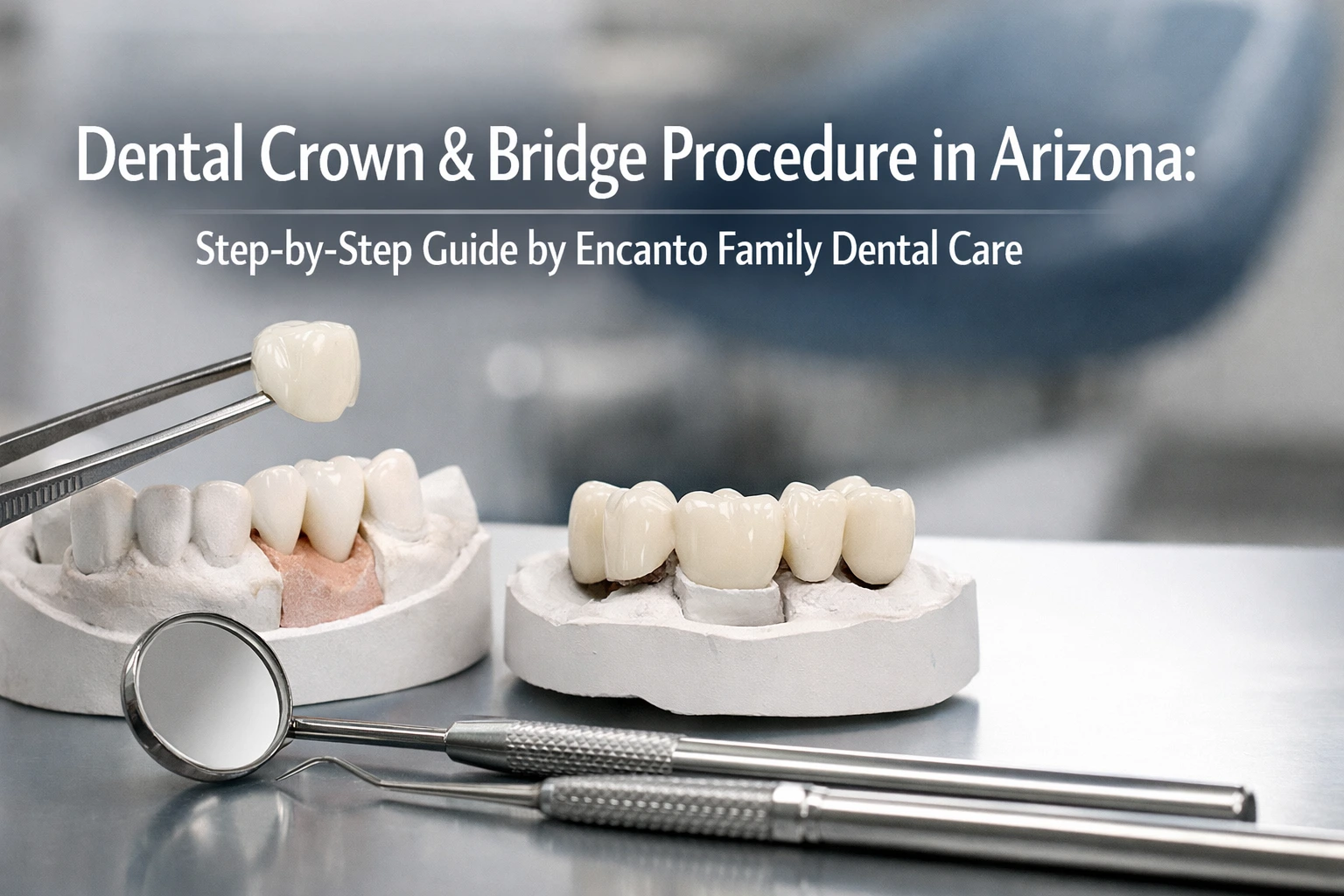
For anybody who has been struggling with damaged or missing teeth, a dental crown or bridge can be life-changing. Not only do they restore function, but these restorations also enhance the appearance and strength of your smile. When you have decay, cracks, or even tooth loss, crowns and bridges can restore the function of your teeth so that you can once again eat, talk, and smile without worrying about how it looks.
Afterward, the dental crown or bridge fitting process typically follows four steps to ensure a secure fit and natural appearance. It can be unsettling to wonder what is entailed as you continue your treatment, but it’s always a good idea to know what you may face. This step-by-step guide demystifies every phase of the process so that you know what to expect when you come in to see Encanto Family Dental Care.
What Are Crowns & Bridges?
Before we jump into the procedure, let’s talk about what crowns and bridges are and their benefit. A dental crown is essentially a cap that fits over (covers) a damaged or decayed tooth, restoring its shape, size, and strength. It is often recommended for heavily filled, cracked, or decayed teeth. On the contrary, a dental bridge is used to replace one or more missing teeth by anchoring artificial teeth to the natural teeth adjacent to them.
At Encanto Family Dental Care, we make these restorations to accommodate your specific needs, so they mesh well with your natural teeth as a long-term solution for function and aesthetics.

Crown & Bridge Process: Procedure Overview
Understanding the process of crowns and bridges in Phoenix is crucial to getting off to the right start. So let’s break down the process. Every step in the process is purposefully crafted to yield the best possible outcome.
Step 1: Initial Consultation
The journey to receiving a crown or bridge starts with an initial consultation. During this visit, your dentist will examine your teeth, gums, and overall oral health to determine the best course of action. You may need to get X-rays to assess how much damage there is or if there’s sufficient tooth structure left to help secure the crown or bridge.
If a crown is required, your dentist will determine whether there are any larger underlying issues (such as decay or infection) that would warrant a root canal before placing the crown. With a bridge, your dentist will check the nearby teeth to ensure they’re healthy enough to support it.
Step 2: Preparing the Tooth
After the treatment plan is determined, the next step includes preparing the tooth or teeth that will receive the restoration. For crowns, this involves filing down the tooth to make space for the crown to be placed over it. That means it must fit firmly and comfortably, which is why this step is so important.
If using a bridge, the prep teeth adjacent (abutments) are reshaped to anchor the artificial tooth(pontic). If the teeth surrounding the gap, or abutments, don’t have enough healthy tooth structure, your dentist might suggest placing crowns on them before installing the bridge.
Step 3: Taking Impressions
Your dentist will make impressions of the affected area after preparing the tooth. These impressions are then used to create personalized crowns or bridges that fit seamlessly on your teeth. Impressions can be done with a traditional mold or using a digital scanner, both of which capture an accurate rendering of your teeth and gums.
If you’re getting a bridge, the impression will capture the entire span of the bridge (from one supporting tooth to the other), so the bridge fits snugly and looks natural.
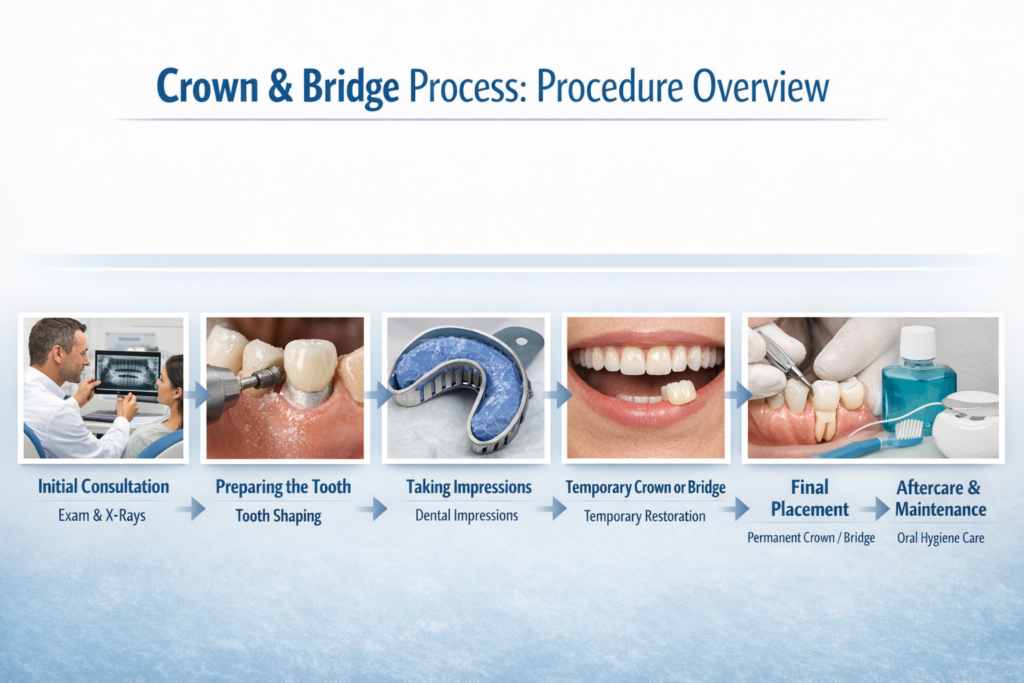
Step 4: Temporary Crown or Bridge
We will then place a temporary restoration over the treated area while your permanent crown or bridge is custom-made by an off-site lab. This procedure allows you to eat and speak comfortably while it’s being made.
The temporary crown or bridge will resemble your natural teeth but isn’t as sturdy as the permanent one, so chewing on hard foods or sticky substances is best avoided.
Step 5: Seating the Definitive Restoration
When your permanent crown or bridge is ready, it’s time for the final fitting. During this visit, the dentist will remove the temporary restoration and check the fit of the permanent crown or bridge. Fit, bite, and shade will all be evaluated to make sure they match your natural teeth.
If things look good, the restoration will be cemented or bonded in place. With crowns, this means placing a cap over the prepared tooth, and with a bridge prosthesis, connecting the replacement tooth to neighboring teeth.
Step 6: Aftercare and Maintenance
Your dentist will provide care instructions for your new restoration once your crown or bridge is attached. Caring for your crowns and bridges is vitally important; you practice good oral hygiene. You still need to brush and floss because plaque and bacteria can build up around the edges of the restoration, which can lead to gum problems or decay under it.
Your dentist may need to perform ongoing evaluations to determine whether the crown or bridge is functioning properly and not damaged over time. With proper care, a crown or bridge can serve you well for many years.
Restore Your Smile with Crowns & Bridges
Crowns & Bridges are a trusted way to really restore your smile and dental health. We treat you with compassion and make sure that every step of the treatment process goes as smoothly as possible, here at Encanto Family Dental Care.
If you’re interested in crowns and bridges to restore your smile, we invite you to schedule a consultation with our team. We’re here to assist you with every detail so your treatment is as comfortable and effective as possible. To schedule an appointment, contact Encanto Family Dental Care and let us help you on your journey to a healthier, more beautiful smile.
Questions People Ask About Crown & Bridge
How long do crowns and bridges last?
Crowns and bridges typically last 10 to 15 years with proper care. Regular brushing, flossing, and dental checkups can help extend their lifespan, ensuring long-lasting function and aesthetic appeal.
Is the dental crown procedure painful?
The dental crown procedure is not painful. Local anesthesia is used to numb the area, ensuring a comfortable journey throughout. Some mild discomfort may occur after the procedure, but it’s usually temporary and manageable.
Can I eat normally after getting a crown or bridge?
Yes, after your permanent crown or bridge is placed, you can eat normally. However, it’s best to avoid hard or sticky foods initially to protect your restoration from damage until it fully sets.
Will my crown or bridge look natural?
Yes, modern crowns and bridges are designed to match the color and shape of your natural teeth. They are custom-made to blend seamlessly with your smile, resulting in a natural, attractive appearance.
Can I get a crown or bridge if I have gum disease?
If you have gum disease, it should be treated before placing a crown or bridge. Healthy gums are essential for the long-term success of restorations, and your dentist will address any gum issues beforehand.
How do I care for my dental crown or bridge?
Caring for your crown or bridge involves regular brushing, flossing, and avoiding hard or sticky foods. Routine dental visits are essential to ensure your restoration stays in great condition for many years.